Claude on a Real Server — Without Giving It Unlimited Access
A real SentinelX session shows the point of the security model: the AI discovers what the host allows, works inside those boundaries, and still gets useful infrastructure work done.
Giving an AI assistant access to a server is useful. Giving it unrestricted access is a very different proposition.
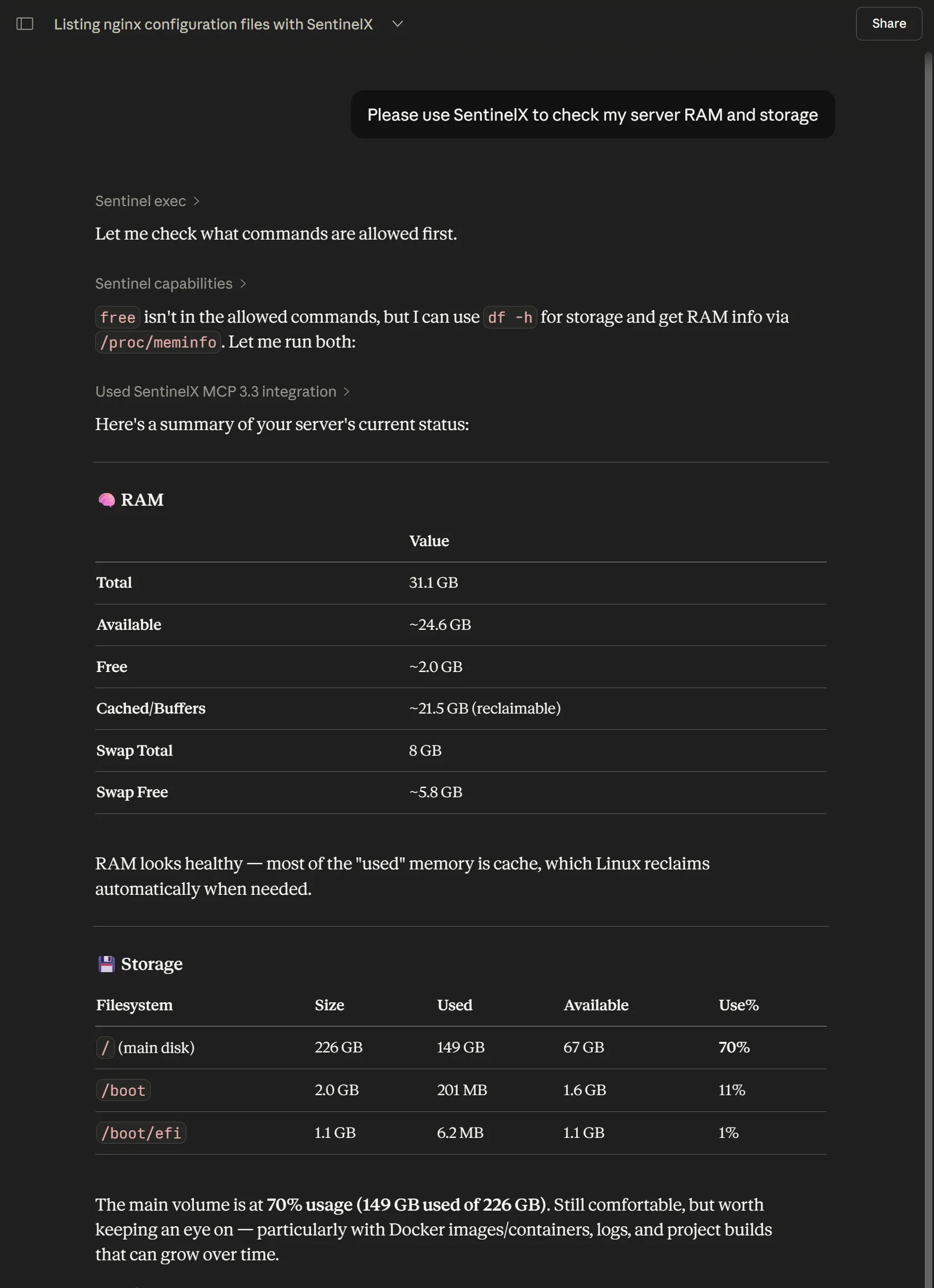
The screenshot below is a simple SentinelX session with Claude. The request is straightforward: check the server's RAM and storage.
The interesting part happens before the command runs
Claude does not begin by assuming it has a shell with unlimited privileges. It asks SentinelX what the host allows.
In this case, Claude discovers that free is not in the command allowlist. Instead of bypassing the restriction, it works with what is available: df -h for storage and permitted access to Linux memory information for RAM.
The result is still useful. Claude can summarize memory pressure, disk usage, and the health of the machine. But the route it takes is constrained by policy defined on the server.
The host defines the boundaries
This is an important distinction in SentinelX: the model does not decide what it is allowed to do. The host does.
A SentinelX agent can expose a deliberately limited set of capabilities, including:
- an explicit command allowlist;
- filesystem paths scoped as read-only or read-write;
- specific services and the actions permitted on each one;
- structured file operations;
- playbooks that describe safe, repeatable operational procedures.
Claude, ChatGPT, or another MCP client can discover those capabilities and reason within them. If an operation is outside the policy, SentinelX refuses it at the agent boundary.
Not just “an LLM with SSH”
The goal is not to turn a language model into an unrestricted remote shell. It is to create a controlled interface between AI and real infrastructure.
That means the AI can still perform useful operational work: inspect a machine, read logs, diagnose services, edit an approved project directory, restart an allowed service, or follow a troubleshooting playbook. But each capability exists because the operator chose to expose it.
Useful infrastructure access is much more interesting when the boundaries are explicit.
AI infrastructure access with a policy in the middle
This small RAM-and-storage check captures the basic SentinelX idea surprisingly well. Claude receives a goal, discovers the server's actual capabilities, adapts its approach, and produces a useful answer without needing unrestricted access.
The conversation remains natural. The enforcement does not.
The model reasons. SentinelX enforces. The server stays in control.